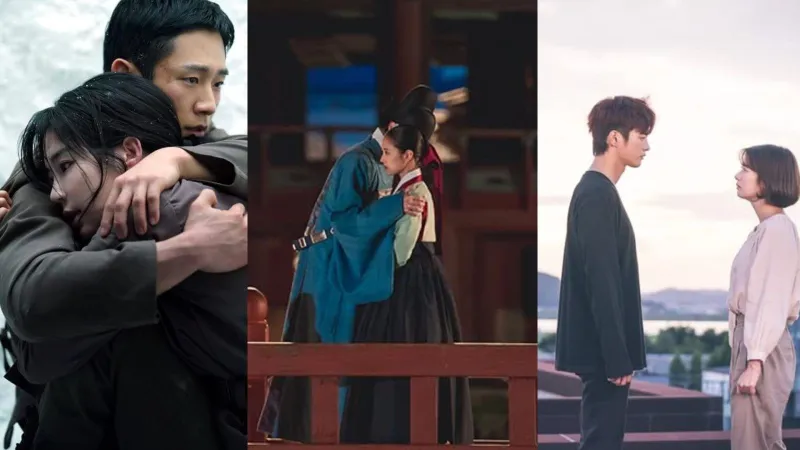
Red Flags, Romantic Lighting, and Why We Keep Falling for K-Drama's Most Toxic Couples
Photo: Unlisted., Public domain, via Wikimedia Commons
Let's be honest with each other for a second.
If a guy grabbed your wrist in a parking garage and told you who you were allowed to talk to, you would call your best friend in a panic. You would screenshot the texts. You might even Google 'signs of a controlling relationship' at 1 a.m. with your phone screen dimmed so your roommate couldn't see.
But when Lee Min-ho does it on screen? Suddenly it's the most romantic thing you've ever witnessed in your entire life.
This is the K-drama paradox — the strange, slightly embarrassing reality that millions of American viewers can identify a toxic relationship in their real lives without hesitation, yet spend twelve episodes desperately hoping the obsessive, emotionally unavailable male lead finally gets the girl. And the shows don't just get away with it. They make it feel earned.
So what exactly is going on here?
The Architecture of the Swoon
K-dramas don't accidentally make unhealthy dynamics look appealing. It's a craft. There's a very deliberate set of storytelling tools being deployed every time a brooding chaebol heir shows up uninvited at the heroine's workplace to glare at her male coworker.
First, there's context engineering. Before the audience ever sees the male lead act possessively, the show has already handed him a tragic backstory — an absent parent, a childhood betrayal, a loss that left him emotionally sealed shut. By the time he's doing something that would get a real person blocked on every platform, the viewer isn't seeing a red flag. They're seeing a wound. The behavior becomes evidence of how deeply he feels, rather than a warning sign about how he might treat someone.
Then there's the music. Seriously, don't underestimate the music. When a sweeping orchestral arrangement floods a scene where a man shows up at a woman's door in the rain without being invited, your nervous system doesn't process 'boundary violation.' It processes 'emotional climax.' The score is doing heavy lifting that the script doesn't have to.
And then there's pacing. A 16-episode drama has the luxury of slowly, methodically building a case for why these two impossible people belong together. By episode eight, you've watched them save each other from car accidents, share umbrellas, cry in parking lots, and almost kiss approximately eleven times. You are invested. At that point, the jealous outburst in episode ten doesn't read as a dealbreaker — it reads as proof that he cares.
Why American Audiences Are Especially Vulnerable to This
Here's where it gets genuinely interesting from a cultural psychology standpoint.
American pop culture has spent the last decade getting pretty good at calling out toxic romance tropes. The conversation around 'Twilight,' for instance, eventually matured into widespread acknowledgment that Edward's behavior would be a nightmare in real life. We developed a cultural vocabulary for this stuff.
But K-dramas arrive with a different set of cultural codes — ones that many American viewers aren't fluent in yet. The emotional restraint that reads as 'cold' in a Western context is understood differently within Korean social norms around hierarchy, emotional expression, and gender dynamics. When an American viewer watches a male lead who barely speaks and controls every situation, they're not reading it through the same cultural lens a Korean viewer might. Instead, they fill in the gaps with their own romantic projections.
There's also the distance factor. Psychologists have long noted that we apply different moral standards to fiction that feels sufficiently removed from our immediate reality. A story set in Seoul, featuring characters navigating a social world most American viewers have never personally experienced, gets a kind of subconscious 'this is different' pass. The exotic setting creates emotional permission to enjoy dynamics that would feel uncomfortable if they were set in, say, Chicago.
The Suffering-as-Proof Problem
One of the most consistent patterns in K-drama romance is what you might call the suffering-as-proof formula. The more a couple endures together — misunderstandings, family opposition, class differences, literal amnesia — the more the show frames their eventual union as deserved. Love, in this narrative logic, is validated by pain. If it didn't cost you something, was it even real?
This is genuinely seductive storytelling. It taps into something deep about how humans assign meaning. We tend to value things we've struggled for more than things that came easily — psychologists call this the IKEA effect, and it applies to relationships too. K-dramas exploit this cognitive bias brilliantly. By making the couple suffer enormously, the show essentially pre-loads the viewer with the feeling that this love is precious, rare, and worth protecting.
The problem is that suffering together and genuine compatibility are not the same thing. A couple who has survived seventeen dramatic crises might have incredible chemistry and zero actual emotional safety between them. But the drama isn't interested in showing you the quiet Tuesday mornings. It ends at the reunion kiss.
Rooting for the Couple vs. Endorsing the Behavior
It's worth saying clearly: enjoying these shows doesn't mean you've lost your critical faculties. Narrative investment is not the same as moral endorsement, and the people watching 'Crash Landing on You' at midnight aren't confused about what a healthy relationship looks like.
What K-dramas are doing — at their best — is something fiction has always done: they're externalizing interior emotional experiences. The possessive male lead who can't stand to see the heroine with anyone else is, in a stylized and heightened way, representing the terrifying vulnerability of loving someone. The drama is literalizing feelings that most of us recognize but would never act on.
The risk isn't that viewers will suddenly find controlling behavior attractive in their real lives. The risk is subtler — it's that repeated exposure to a specific narrative grammar, where jealousy signals depth and emotional volatility signals passion, can quietly calibrate what 'intensity' feels like in a romantic context. When real relationships feel calm and communicative, they can start to feel, by comparison, a little... flat.
What You Can Do With This Information
None of this means you should stop watching. Please don't stop watching. DoRamy exists precisely because this content is worth engaging with seriously.
But it does mean that the most interesting thing you can do with a K-drama is watch it actively. Notice when the music is doing emotional work the scene hasn't earned on its own. Notice when a backstory is being used to excuse behavior rather than explain it. Notice when 'he's broken and only she can fix him' is being presented as the romantic ideal.
Because the best K-dramas — and there are genuinely brilliant ones — actually know they're playing with fire. They build in moments of consequence, of the female lead pushing back, of the toxic dynamic being named rather than just romanticized. The storytelling gets richer when you're watching for that layer too.
And honestly? Being the viewer who can love the swoon and see through the manipulation is kind of the whole game.